Tarikh : 11-13 Julai 2011 (Isnin hingga Rabu)
Masa : 8.00 pagi - 5 petang
Tempat : Makmal Kewartawanan, FBMK, UPM.
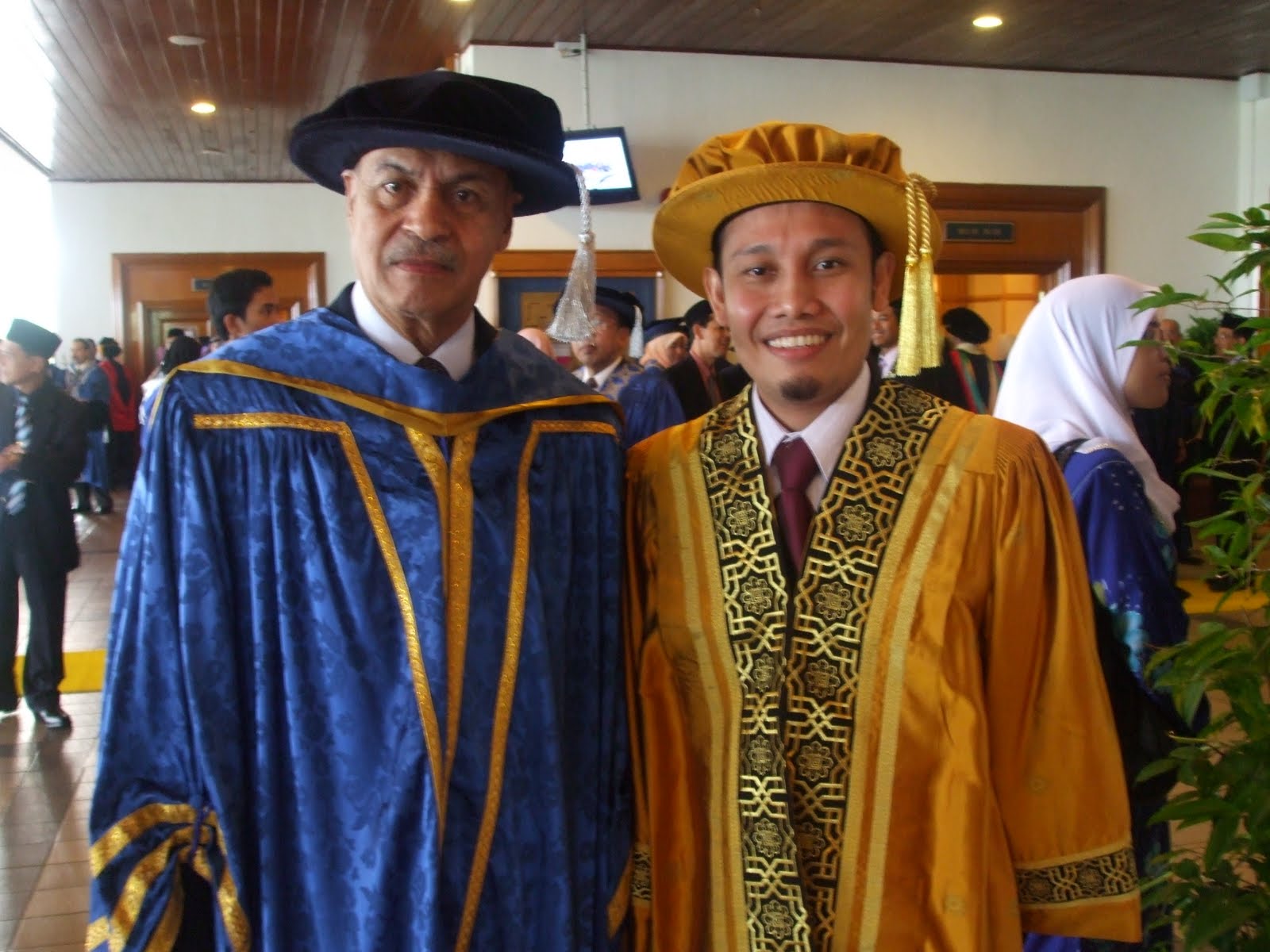

Convo UIA'08
Saturday, July 9, 2011

Ph.D Tip: Don't Be Afraid to Ask for Help
Time for another dissertation tip.
Today's tip has to do with asking for help. So many ABD's lose so much time in their dissertation process because they don't ask for help when they need it.
How do you know you need help? When you feel overwhelmed, unfocused, or distracted about the dissertation. When you dread working on it, or find yourself procrastinating to avoid working on it. When you have a crucial step that must be taken in order to move ahead, but you're just not taking that step.
For example, if you need to get data entered or transcribed, and you find yourself procrastinating on doing this, you probably want to ask for help. Even though it might seem strange, pay someone to enter your data so you can get moving again. You can move on to data analysis until your data is entered. Similarly, if you're putting off revisions or formatting, pay someone to do this for you.
Not everything has to be done by you, alone.
Until next time...
Tuesday, June 14, 2011
Ph.D. Comprehensive Examination
Department of Communication
University Putra Malaysia
Ph.D. Comprehensive Examination
Name of candidate:
Muhamad Fazil Bin Ahmad
Date:
- Candidate picks up the examination questions from the chairman of supervisory committee on the morning of
- Candidate is given one week to answer all questions. It is a take home examination.
- All answers must be typed using computer, double-spaced on one side of the paper and using font size 12 point. Answer each question separately and type the question on top the front page of each answer script. Number the answer pages accordingly.
- The length of answer for each question is about 12 – 15 pages.
- References cited should be listed at the end of the respective answer script. The references used should be as current as possible.
- Submit three (3) bound copies of your answer script to the chairman of the supervisory committee by
- An oral examination will be conducted after all examiners had read and evaluated the answer scripts.
- Candidate may consult the respective lecturer who prepared the question for clarification.
- The examination result will be disqualified if element of plagiarism is found in the answer script.
Duration of CE : 13th – 20th June 2011 (8 Days Only)
Question 1: Communication/related Theory
Question 2: Research Methods
Question 3: Statistics
Question 4: Domain of Thesis Studied
Instructions:
1. There are FOUR (4) questions in this part.
2. Answer ALL questions.
Question 1: Communication/related Theory [10 marks]
1. The Public Relations Division of International Communication association is now seeking nominations for the best theory on corporate communication. Which theory would you nominate and accordingly provide justifications of your choice?
Question 2: Research Methods [10 marks]
2a. What do you understand by key points, “conceptualization” and “operationalization”?
2b. Considering the possible relationship between CSR initiatives and corporate reputation, describe how that relationship might be examined (a) deductive and (b) inductive methods.
Question 3: Statistics [10 marks]
3. Please give your critique on statistical procedures used by the researchers in the accompanying journal article. Support your critique with some reference, why the researchers used that the statistical procedures for their research. Finally, please indicate another possible research objective(s) and statistical procedure(s) would be your suggestion to the researchers to improve their finding. Why?
Source of journal article
Wan, Hua-Hsin and Schell, Robert (2007). Reassessing Corporate Image—An Examination of How Image Bridges Symbolic Relationships With Behavioral Relationships, Journal of Public Relations Research, 19: 1, 25 — 45
Question 4: Domain of Thesis Studied [20 marks]
4a. How would you describe the differences between related constructs such as corporate image, corporate identity and corporate reputation of the organization?
4b. What are possible theoretical practical implication of city branding as discussed in the article below? Why does brand personality concepts are used to study branding places? Do you agree that there are similarities between brand personality and brand positioning with regards to place branding?
Source of journal article
Melike Demirbag Kaplan, Oznur Yurt, Burcu Guneri, and Kemal Kurtulus. (2010). Branding places: applying brand: personality concept to cities. European Journal of Marketing Vol. 44 No. 9/10, 2010 pp. 1286-1304 .


Wednesday, June 8, 2011
Ph.D Tip: Take Big Actions Once Per Month
Dear Muhamad,
Hey, it's good to be with you again. How is the dissertation progress going?
Today's tip has to do with taking big action on your dissertation.
While, generally, I tend to favor small steps, consistently taken, there are times in the process where you won't be able to accomplish very much in small blocks of time. You'll need to set aside a larger chunk of time in order to accomplish something
significant.
My recommendations for doing this would be to try and set aside a day once a month or once every two months in which you have several hours to devote to your dissertation. Plan that into your schedule for the next six months. Guard this time as you would any other important appointment.
Plan ahead of time what you'll work on during this period, and start early in the day. Use this block of time wisely, and you could make enough significant progress on the dissertation to motivate you to keep going. When you commit to your project in terms of time and energy, you will be more likely to see it through.
Dr. Rachna Jain
Friday, May 27, 2011
Dissertation Writing as an Endurance Sport
Hi, Muhamad!
Wow! What a week! Things have been wildly busy around here. I hope you're doing well and are happy with your dissertation progress.
Here's another thoughtful dissertating article for you!
Wow! What a week! Things have been wildly busy around here. I hope you're doing well and are happy with your dissertation progress.
Here's another thoughtful dissertating article for you!
Hope this will give you an extra boost of endurance. Keep moving.
Take care, and see you next time!
Dr.Rachna
Take care, and see you next time!
Dr.Rachna
(Muhamad's Phd. external supervisor)
Dissertation Writing as an Endurance Sport
by Michael Kelly
Ph.D. Candidate
Writing a dissertation and training for an Ironman triathlon don't seem to have a lot in common. For one thing, triathletes (both male and female) tend to shave most of their body hair in an effort to save time, whereas graduate students (both male and female) tend NOT to shave in an effort to save time.
Truth be told, both pursuits have much more in common than most people would think. And keep in mind that as a triathlete, I'm neither fast, nor good, nor particularly talented. I'm slow but stubborn, which is a useful trait in dissertation writing as well.
So, what characteristics do dissertation writing and Ironman training and racing share?
Coffee ... lots of coffee. There's just no way around it -- riding a bike or reading academic books and articles for six hours at a time enslaves you to "the bean".
We Sleep When We Die. This may be a chicken-or-egg relationship with #1, but both dissertation writing and endurance training require you to adapt to less sleep than your body needs. Should you get 8 or 9 hours? Sure. Do you get 4 or 5? Usually there just aren't enough hours in the day to do everything you need to do.
The Fogie Factor. Aren't you tired of hearing your advisors tell you about how they had to run their data by submitting punch cards to lab-coated computer attendants, or that when THEY took their comprehensive exams they had to write it longhand with dull pencils, or that THEIR advisor made them (blah, blah, blah).
Triathlon's the same way -- there's always some fogie telling you about how he had to ride a 45 pound Sears 10 speed in jean shorts and tennis shoes up Torrey Pines Road, or the time that it was 117 degrees and (blah, blah, blah). Guess what? The new technology doesn't make it any easier -- your brain still needs to come up
with an original thesis and analysis that you have to sustain for several years and several hundred pages, and your body still has to propel you through 2.4 miles of swimming, 112 miles of cycling and 26.2 miles of running. No amount of technology can blunt the fact that these are Very Hard Things.
Talent Is Overrated. Any TV coverage you've seen of Ironman completely overplays the stumbling, the vomiting, the grimacing ... the truth of racing and training is much more mundane, and most of it is mental -- you keep yourself going out of stubbornness, and if your body tries to quit, your mind needs to do some serious smackdown to quell the corporeal rebellion. Same thing with dissertation writing -- yes, your brilliance helped create that inspired flash of insight that lies at the heart
of your thesis, but the rest of your dissertation gets written through sheer will as you spend a few years of your life drawing together the evidence and arguments into a book-length project.
What gets you through in both cases is not any particular talent, but a willingness to keep plugging away until you're done.
Most people just don't get it. Let's face it -- for most people, getting a Ph.D. is not the most rational way to spend 4-6 years of their lives.
You've gotten tired of explaining to the relatives at the holidays that you're still in school and that you're still working on "that really big paper," and you've given up trying to explain why you find your dissertation's topic so interesting. Training for an
Ironman leads to similar reactions from friends and family: "You're doing what? For how long? In one day?" Most triathletes have given up trying to explain the allure of 10-17 hours of self-propelled motion to uncomprehending loved ones.
In both cases, you're trying to explain the unexplainable. Though it's hard to remember when you've been focusing on the same narrow topic for three years or when you've been sitting on the same narrow bike seat for three hours, you started with an internal spark of some kind, a burning curiosity about what's out there and what's possible, and about whether or not you could do it. In both cases the underlying reasons tend to be intensely personal and hard to explain, which makes it all immensely satisfying in ways that are impossible to verbalize to "outsiders."
Where Does It End? In both Ironman racing and in dissertation writing, everyone hits at least one wall where they say (scream) to themselves "I AM NEVER GOING TO FINISH THIS THING!" Finishing seems so far away, and what you need to do to get there looks so inconceivably huge that it seems utterly unattainable. It makes you
doubt yourself intensely, but in both cases you need to remember that this feeling happens to everyone and does NOT indicate your unworthiness. It's universal.
What you have to do instead is focus intensely on whatever small task you're involved in at the moment -- whether that be pedaling to the top of the next hill or editing your first two chapters -- and forget (as much as you can) the Big Picture with all the fear
and loathing that comes with thinking about it.
You string together enough of those little jobs and you finish -- it's that simple.
I could go on and tell you about how both triathletes and graduate students survive on pasta to a degree that would disgust any Atkins adherents they know, or how they tend to make passersby nervous by frequently talking to themselves out loud, but I think you get the point.
Dissertation writing IS an endurance sport, and like all endurance sports it demands (and rewards) those who can give a steady, measured effort.
Michael Kelly is a Ph.D. candidate in the Political Science
Department and a Research Fellow at the Brookings Institution in
Washington, D.C., which is a MUCH colder place to run this time
of year than La Jolla.
Friday, May 6, 2011
How to Organize Your Bibliography
I know of a fantastic research/organization tool and thought it would be perfect to share with you!
Have you ever stopped by http://www.endnote.com ? This is a great resource for keeping track of all of your bibliographic material. You just type in the citation once,
and you have it ready to use from there on. Endnote also can generate a bibliography for you, which is great for the last minute deadline on printing the final copy and
getting it ready to turn in.
If you know that you need to get your bibliographic material organized, definitely check out Endnote. It can save you time and money. Also, be sure to check if they still offer a student discount. [No sense in spending more than you have to, right?]
Be sure to find out if they have a trial version so you can try before you buy.
If you know you don't like Endnote, but are still looking for another bibliographic resource? Check out Procite.
Sunday, May 1, 2011
Avoid "all or nothing"
Avoid "all or nothing" or "black/white" thinking about your dissertation.
"My dissertation will never be done if I don't spend 18 hours a day on it." "I have to read EVERYTHING ever written so this is good enough." No statement that has the words: "always", "never", "should", "ever" can possibly be true - these are good "watchwords" for all or nothing type thinking.
Remember- in the dissertation, as in life- if you aren't feeling good about what you're doing, it may mean that you're thinking the wrong way.
Wednesday, April 20, 2011
Ph.D Tip: Resource if You're Using Microsoft Word
How's it going?, Muhamad.
Wow. I can't believe it's time for another issue already. How are things going? What are you most proud of accomplishing in the past two weeks?
Here is one of the most helpful dissertating books I've seen lately: Writing Your Dissertation with Microsoft Word.
Author Vince Kiernan actually gave me the opportunity to review this book prior to publication. (If you purchase it, you'll see my testimonial!).
Anyway, the book is solidly written, with clear instructions on how to set up formatting in Microsoft Word. This will be a helpful resource for getting everything looking just right- and Vince's tips will save you time in the final hours.
If you are using Microsoft Word and want to learn how to format your dissertation properly the first time, I'd suggest getting this book.
You can get it here:
That wraps it up for now. Hope this helped.
Talk to you again soon!
--Rachna
Wednesday, April 6, 2011
Ph.D: A Tip to Boost Your Creativity
Hi, Muhamad!
One way to boost your dissertation creativity is to practice taking different perspectives.
If you have been writing from a particular voice or viewpoint, and you find yourself "stuck' and unable to move ahead, it can be valuable to try taking another perspective.
If you are writing a history dissertation, for instance, think about the problem or concept from the viewpoint of someone who would have been directly impacted by the problem. For instance, if you are writing about the historical plight of itinerant farm workers, you can find a new voice or new perspective simply by viewing the problem from a personal viewpoint, rather than a purely academic one.
For example, if you are discussing the lack of access to resources, you can find a new voice by writing about what that would have meant on a daily basis: traveling miles and miles to procure food- perhaps walking those many miles. Lack of access to education, and how that would have limited options or opportunities. Poor living conditions which would have led to diseases or illness.
This kind of perspective taking can help you really "dig into" the problems these people were experiencing, and, perhaps, may afford you some greater insight to write from.
When writing papers about the history of a people or group or society, be sure to demonstrate an understanding of the actual challenges they faced- perhaps in their own voice. Can you find stories they passed down? Can you frame your paper through the eyes of one particular individual, who becomes a prototype for the whole group?
Practice taking different perspectives with your dissertation. Doing so will shift it from a dry, academic exercise to one filled with energy, interest, and life. And, really, isn't that what drove your topic choice in the first place?
Take care, and see you next time!
--Rachna
Tuesday, April 5, 2011
Revisit Your Working Schedule
Hi, Muhamad,
Another important tip for you.
This week, I'd like you to set up (or revisit) your current dissertation working schedule.
Too often, ABD's get stuck in a cycle of binge writing and binge avoidance, which means, simply, that they write feverishly to reach some real (or imagined) deadline, and then just as intensely avoid the dissertation for a set amount of time after
the deadline.
While it can be seductive to be this productive (even though it's usually followed by a nosedive in motivation and energy), it's not a good long-term strategy for completing the dissertation.
And you want to finish, right?
So your better bet is to set smaller, more frequent deadlines, and to work consistently to them. Give yourself regular time off, as well as rewards for your progress.
Not as flashy, I know, but way better in the long run.
Until next time,
--Rachna
Thursday, March 24, 2011
Writing the Abstract
By External supervisor: Dr. Rachna D. Jain (Ph.D)
To: Muhamad Fazil Ahmad
To: Muhamad Fazil Ahmad
Hi!, Muhamad.
Here's an informative dissertating article I'd like to share with you. It's on tips for writing the abstract. I've noticed that many people finally get through the entire dissertation and then are stumped on finishing the abstract. Please consider saving this article until you're ready to write your abstract.
***************
The Writing Center Guide to Writing an Abstract
An abstract is a short informative or descriptive summary of a longer report. It is written after the report is completed, although it is intended to be read first. In a technical report, the abstract appears on a separate page after the table of contents and list of illustrations.
In an essay written for a humanities class, it most likely should appear on a separate page, just after the title page and therefore just before the essay itself.
There are two distinct types of abstracts:
A DESCRIPTIVE abstract merely identifies the areas to be covered in the report. It is an extended statement of purpose or scope. Such an abstract is only useful for a very long report, because it demonstrates only the paper's organization, not its content.
An INFORMATIVE abstract summarizes the entire report and gives the reader an overview of the facts that will be laid out in detail in the paper itself. It is rarely longer than one page and should never exceed more than 10% of the length of the entire report; otherwise it defeats its own purpose.
Several potential uses for abstracts:
An executive preparing a comprehensive report might ask her assistant to abstract articles from different levels of periodicals to provide information quickly and to help her decide whether to read the complete articles.
A professional might read the abstract accompanying a journal article to decide if it is worth her time to read the full article.
Libraries subscribe to abstracting journals and series (including Dissertation Abstracts International) to provide an overview of content.
Certain congressional and association newsletters provide abstracts of newspaper articles that pertain to issues relevant to their memberships.
How to write an informative abstract:
Plan to write an abstract that is no more than 10% of the length of the essay.
In the first draft, note key facts, statistics, etc. that you need to include.
Do not include a statement of scope; a sentence like "this paper will look at...." is inappropriate in an informative abstract.
Be sure to omit or condense lengthy examples, tables, and other supporting detail.
Revise the draft into smooth, stand-alone prose; the abstract itself should be a mini-essay.
Edit the revision. Be sure that the abstract is complete and accurate.
Double check that the abstract is written in the same voice as is the paper.
Orginally excerpted from:
It's been great connecting with you. Hope you enjoyed this issue.
See you again soon!
--Rachna
Friday, March 18, 2011
Utilize Your University Resources
By External supervisor: Dr. Rachna D. Jain (Ph.D)
To: Muhamad Fazil Ahmad
To: Muhamad Fazil Ahmad
Hi- me again!, Muhamad
Here's a dissertating tip I discovered that's been a lifesaver for me and many others.
Utilize your departmental/University resources.
This sounds pretty self-evident, perhaps, but you might be surprised at how many resources your department or University has that can support your dissertation progress.
Examples might include grants or fellowships, editors, statisticians, access to specialized references, interlibrary loan, just to name a few. Sometimes, you can also get discounts on helpful software and other tools to make your dissertation process easier. Start looking!
Always try to find the easiest ways possible to accomplish all of your dissertation tasks.
Until next time,
--Rachna
Wednesday, February 23, 2011
Persistence is Essential to Complete Your Dissertation
By External supervisor: Dr. Rachna D. Jain (Ph.D)
To: Muhamad Fazil Ahmad
Another great dissertation tip for you, Muhamad.
Persistence is essential if you are going to complete your dissertation. That persistence must transcend normal day-to-day activities, as well as unexpected events. Life is generally what get between you and completing your dissertation- the difficulty of doing your dissertation is rarely in the execution of the writing or research.
While I know that many of you feel that writing the paper is, without a doubt, the most difficult part of completing your dissertation, the fact is that this problem has a series of ready solutions. You can hire a dissertation coach, or an editor, attend a writing workshop, or get feedback from your colleagues and peers.
But taking those steps can only happy when you believe you can actually complete the dissertation in a timely fashion and have it turn out with the result you desire. That is, you must feel confident in your capacity to craft a dissertation that you and your advisors are satisfied by.
If you do not believe that you can complete the dissertation and you don't believe it can happen the way you want, then, naturally, you are not going to take actions that will achieve that outcome. That is, if you believe "there's no way I can write this chapter" or "there's no way I can process the results of this survey," then you will not accomplish those goals.
If you believe, like I do, that you will achieve what you believe you can achieve, you will take actions that mirror those beliefs.
-Rachna-
To: Muhamad Fazil Ahmad
Another great dissertation tip for you, Muhamad.
Persistence is essential if you are going to complete your dissertation. That persistence must transcend normal day-to-day activities, as well as unexpected events. Life is generally what get between you and completing your dissertation- the difficulty of doing your dissertation is rarely in the execution of the writing or research.
While I know that many of you feel that writing the paper is, without a doubt, the most difficult part of completing your dissertation, the fact is that this problem has a series of ready solutions. You can hire a dissertation coach, or an editor, attend a writing workshop, or get feedback from your colleagues and peers.
But taking those steps can only happy when you believe you can actually complete the dissertation in a timely fashion and have it turn out with the result you desire. That is, you must feel confident in your capacity to craft a dissertation that you and your advisors are satisfied by.
If you do not believe that you can complete the dissertation and you don't believe it can happen the way you want, then, naturally, you are not going to take actions that will achieve that outcome. That is, if you believe "there's no way I can write this chapter" or "there's no way I can process the results of this survey," then you will not accomplish those goals.
If you believe, like I do, that you will achieve what you believe you can achieve, you will take actions that mirror those beliefs.
-Rachna-
Wednesday, February 9, 2011
Top 10 Lies Told By Graduate Students
PhD External Supervision By Dr Rachna
For: Muhamad Fazil Ahmad
For: Muhamad Fazil Ahmad
Well, we're back again with another PhD tip! Hope you're feeling great and having a terrific week!
Well, before I share today's tip, I have to tell you this joke I heard. You might have heard it before, but I hadn't- and I think it's pretty funny. Some words have been disguised to avoid triggering spam filters.
The Top Ten Lies Told by Graduate Students
-- taken from the Harvard Crimson
10. It doesn't bother me at all that my college roommate is making $80,000 a year on Wall Street.
9. I'd be delighted to proofread your book/ chapter/article.
8. My work has a lot of practical importance.
7. I would never date an undergraduate.
6. Your latest article was so inspiring.
5. I turned down a lot of great job offers to come here.
4. I just have one more book to read and then I'll start writing.
3. The department is giving me so much support.
2. My job prospects look really good.
1. No really, I'll be out of here in only two more years.
Saturday, January 15, 2011
15 Tips for My Ph.D. Completion
By: Dr. Rachna D. Jain
For: Muhamad Fazil Ahmad
Tip #1: Create a backwards planning timeline.
In this process, you set your desired defense date, and then work backwards to construct deadlines for each chapter or section. This will help you know- exactly- what you need to accomplish in order to defend on your desired date.
Tip #2: Stay in regular touch with your advisor.
It can be tempting to only contact your advisor when you have completed a major section of writing. However, if you don’t complete the writing as planned, you end up avoiding your advisor. This can make the process more difficult than necessary.
Tip #3: Keep your other commitments to a minimum.
In order to complete your dissertation quickly, you may need to refrain from taking on any additional (optional) commitments. In order to finish most quickly, you should focus on self care, relationships, and finishing the dissertation.
Tip #4: Frequently assess the scope of your topic.
When you’ve worked on the dissertation for a while, it’s common for the project to (unintentionally) become larger. Make regular assessments as to the scope of your topic, taking care that it remains manageable.
Tip #5: Get more support than you need.
Have at least 3-5 people that you can access for emotional, writing, and social support. This will keep you at your best during the whole process.
Tip #6: Realize the dissertation is not a test of your intelligence.
Completing the dissertation has always been and will always be more about your abilities to independently organize, research, and write on a particular topic. It has to do with demonstrating certain skills, not defining your native intelligence.
Tip #7: Use the smallest possible unit to get you started.
This may mean spending as little as one to five minutes on your work, initially. If you have been procrastinating and avoiding your work, you need to “re-train” your perceptions to realize that this isn’t so bad and that you actually like your work.
Tip #8: Allow this to be as easy as possible.
Doing a dissertation might not be painless, but try not to make it more painful than it needs to be. Like any other project in your life, it will get done if you work consistently towards it. I ask my clients to keep in mind the words, “easy and done”, which they may repeat when they feel the project or process is becoming too difficult. Try using this phrase when you feel worried or bad about your work. It may help you move back into it, more easily.
Tip #9: Don’t play the comparison game.
Everyone is different, and each student approaches the dissertation in his/her own way. It is not helpful to compare yourself to other students, mainly because everyone is different and has different resources to apply to the dissertation. Again, keep focused on your work and your game plan and your progress.
Tip #10: Understand that others may not “get it”.
Many times, my clients are frustrated by the people in their lives asking, “When will you be finished?” and “What’s taking so long…just write the darn thing.” You can choose to explain your actions, or you can try and find a way to make others understand. But if both of these don’t work, just know that it sometimes takes going through the process to know what it’s about.
Tip #11: More of everything is not always better.
Many graduate students behave as if extra work, extra time, extra energy always results in higher quality output. This is actually not always the case. Learn to find that balance between working hard and working smart.
Tip #12: Realize that each advisor will have different standards for an acceptable dissertation.
If you want to know your advisor’s preferred approach, ask. It can also be useful to review or study other dissertations s/he have chaired.
Tip #13: Think of this like a marathon, not a wind sprint
Most students treat the dissertation as a wind sprint, not a marathon. This means that they work all these hours at the beginning, get their lives out of whack, push themselves ‘til they “crash”, and then can’t get back to work after this. If you can see this process like a marathon, you’ll know that you need to keep a steady and even pace to finish!
Tip #14: Build the dissertation into your day as much as possible.
Integrating the dissertation into your daily life is a fantastic habit. It is much more helpful than placing it in its own category, where it begins to become an overwhelming and looming task.
Tip #15: If you get stuck for more than 1 month where you’ve not worked on the dissertation at all, take BIG action.
Join (or create) a support group, get a coach, do something. If you had cut your finger, you’d (hopefully) clean and bandage it. You wouldn’t just let it keep bleeding and wait to see “what happened”. Getting stuck in the dissertation is the same way. When you first see yourself getting stuck and feeling bad, prevent this from going further.
Subscribe to:
Posts (Atom)
Popular Posts
-
 DEFINISI KOMUNIKASI Oleh: Muhamad Fazil Ahmad “Kalau kamu berada di rumah orang, hendaklah kamu jaga matamu, jika kamu berada di t...
 -
 Having completed and submitted the thesis, a candidate will then have to prepare for the viva session. A viva is basically an oral...
 -
 Department of Communication University Putra Malaysia Ph.D. Comprehensive Examination Name of candidate: Muhamad Fazil Bin...
 -
 PhD PROJECT : By: Muhamad Fazil Ahmad PhD Candidate UPM MEASURING DETERMINANTS OF CITY BRAND FOR INSTITUTIONALIZING STRATEGIC COMMUNICATIO...
 -
 Oleh: Muhamad Fazil Ahmad “Tiga rukun yang benar dan perlu dalam mencapai utama iaitu dengan tabiat, dengan pengalaman dan dengan pelajaran....
 -
 Khutbah ini disampaikan oleh Baginda Nabi Muhammad s.a.w. pada 9hb. Zulhujjah tahun 10 hijriyyah di Lembah Uranah Gunung Arafah. Wa...
 -
Dalam Islam terdapat pengajaran yang menyatakan ‘sembilan persepuluh dari rezeki itu ada dalam perniagaan’. Ini bererti jika kita ingin mend...
-
Bahasa Inggeris merupakan satu bahasa yang amat penting dewasa ini. Malahan kerajaan telah menyatakan bahawa sesuatu bangsa tidak akan maju ...

